
Key Takeaways
- Texas law bars children under 8 or shorter than 4’9″ from riding in the front seat.
- Child safety seats must match the child’s age, weight, and height per manufacturer guidelines.
- Front-seat airbags pose a serious, potentially fatal risk to young passengers in any crash.
- The American Academy of Pediatrics recommends that all children under 13 ride in the back seat.
- Improper seating can affect fault determinations and damages in a personal injury claim.
Most parents do not think twice about it until the moment their child asks to sit up front. When can a kid ride in the front seat? The answer depends on more than age. Texas law, airbag science, and pediatric safety guidance all point in the same direction, and understanding what they require can be the difference between a safe ride home and a life-changing injury on a Sugar Land road.
Our Car Accident attorneys at Reed & Terry Law Firm have seen firsthand how these details matter when families need help after a crash.
Speak With a Car Accident Lawyer Today
Texas Legal Age and Height Rules
| Child’s Age/Height | Texas Requirement |
|---|---|
| Under 8 years old | Child safety seat required under Texas law. |
| Under 4’9″ tall | Use a properly fitted child safety seat or booster. |
| Under 13 years old | The back seat is strongly recommended by the American Academy of Pediatrics, even when Texas law no longer requires a child safety seat. |
Texas law sets a clear standard. Under the Texas Transportation Code § 545.412, a child younger than 8 years old must be secured in a child passenger safety seat system, not in the front seat of a vehicle. The same restriction applies to any child shorter than 4 feet 9 inches, regardless of age. A child who is 8 years old but still under 4’9″ does not automatically qualify to move to the front seat.
Violating this law is a misdemeanor in Texas, and the driver is legally responsible. If a child was improperly seated during a car accident in Sugar Land, that fact can become a significant issue in any subsequent legal proceeding.
Child Safety Seat Requirements
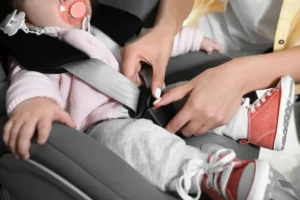
Texas law governs not only where a child sits but also how they must be restrained. A child passenger safety seat must follow the manufacturer’s instructions and must be appropriate for the child’s age, height, and weight. Placing a child in a seat that no longer fits them correctly defeats the purpose of the restraint entirely, and it can expose the driver to legal liability if a crash occurs.
Under 8 Years or Under 4’9″ Tall
Children in this category must use a child safety seat or booster seat in the rear of the vehicle. Rear-facing infant seats apply to the youngest children. As a child grows, a forward-facing harness seat takes over, followed by a belt-positioning booster. Each stage transfers crash forces across the strongest parts of a child’s body. Moving a child out of these stages too early increases the risk of injury during a collision.
Airbag Dangers for Young Children
The front passenger seat is equipped with a supplemental restraint system that deploys at speeds exceeding 100 miles per hour. For adults, that deployment is a lifesaver. For small children, it can cause fatal injuries. According to the National Highway Traffic Safety Administration, children are at serious risk of head and neck injuries when seated in front of an active airbag, even in low-speed crashes.
A booster seat in the front of a vehicle still places a child within the airbag’s deployment zone. The back seat eliminates that risk entirely, which is why the law and medical experts align on the same recommendation.
Get Your Free Case Review
No Upfront Fees (888) 576-4669Expert Safety Recommendations
Texas law tells you the minimum. The American Academy of Pediatrics recommends that children remain in the back seat until at least age 13, regardless of height or whether they have cleared the legal front-seat threshold. A child’s skeletal structure continues developing well past age 8, making them more vulnerable to seat belt injuries and airbag contact even when properly restrained.
Knowing when a kid can ride in the front seat is not just about compliance. If another driver’s negligence causes a crash and a child is injured, the seating position and restraint method can affect how a personal injury claim is evaluated, including fault determinations and damages. An experienced attorney can help families understand where liability falls and what compensation may be available.
Contact Reed and Terry After an Accident
When a child is injured in a car accident in Sugar Land, the legal and medical stakes are high. Reed & Terry Law Firm has represented injury victims throughout Fort Bend County for more than 30 years, including cases involving children and front-seat passenger injuries.
If you need to understand your rights after a crash, call us today at (281) 491-5000 for a free consultation. When can a kid ride in the front seat? The answer could make all the difference.

When you’ve been injured because of someone else’s negligence, you deserve experienced legal guidance from attorneys who understand what’s at stake. The attorneys at Reed & Terry Law Firm have spent decades helping injury victims across Sugar Land, Fort Bend County, and throughout Texas pursue the compensation they deserve. Through personalized representation, thorough case preparation, and dedicated advocacy, our team works to protect your rights while helping you move forward with confidence. Learn more about our attorneys or schedule your free consultation today.